

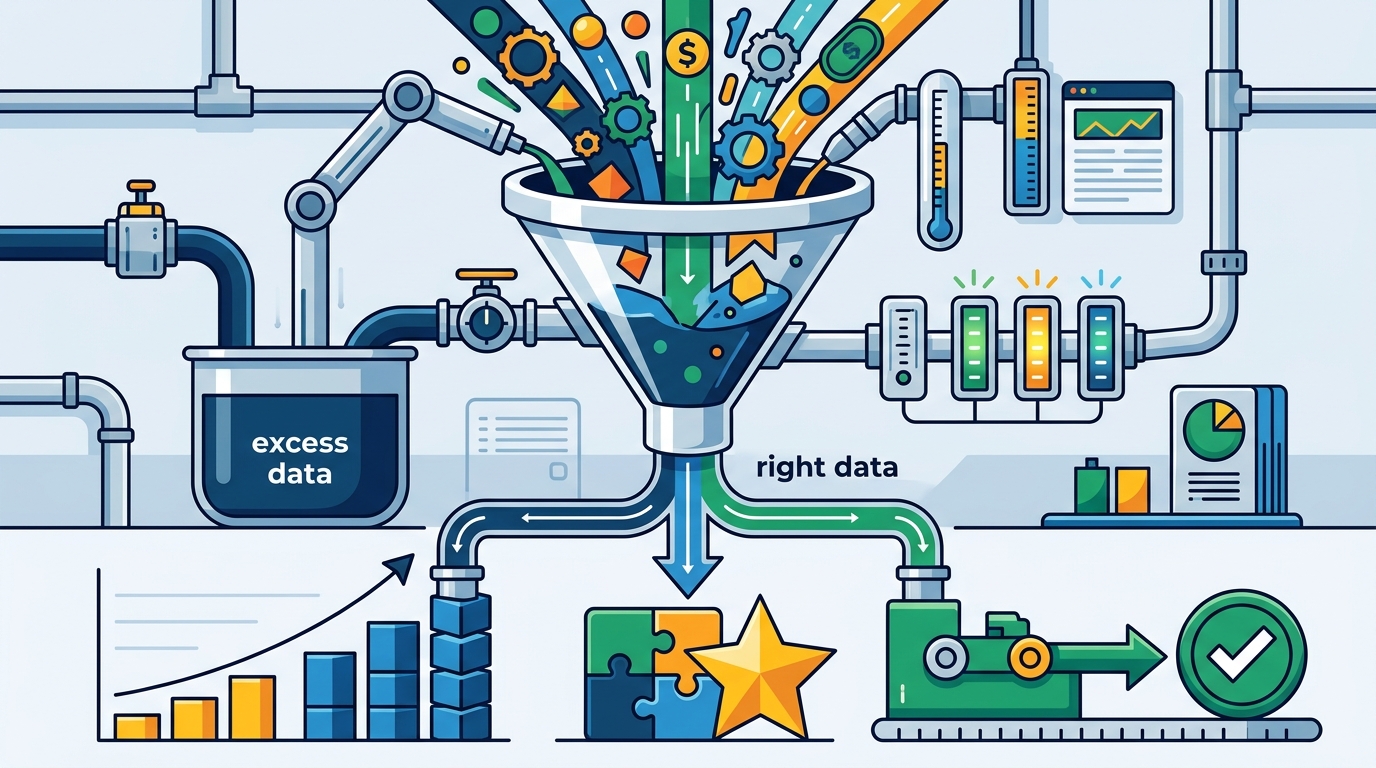
Every marketing dollar you spend should be traceable to a business outcome. Yet 83% of marketers say proving ROI is their top challenge. The solution is not more data; it is the right data. Key performance indicators (KPIs) give you a focused scorecard that connects campaigns to revenue, growth, and customer retention. In this guide, we break down the KPIs that matter most in 2026, explain how to choose the right ones for your business, and show you how to turn raw numbers into strategic decisions that drive real growth.
What Are Marketing KPIs?
A key performance indicator (KPI) is a measurable value that demonstrates how effectively a company is achieving key business objectives. In marketing, KPIs are the vital signs that connect your activities directly to goals like revenue, lead generation, and customer retention.
Unlike raw data points, KPIs provide actionable insight. They tell you whether your strategy is working and where you need to adjust. At Infinity Media, we walk through each part of the funnel to identify the KPIs and areas of weakness, then build action items and tests to address them.
KPIs vs. Metrics: What Is the Difference?
A metric is any quantitative measurement, such as page views or email opens. A KPI, on the other hand, is a strategically selected metric tied to a specific business objective that drives decision-making. Not every metric qualifies as a KPI. For example, total page views is a metric; conversion rate on a landing page tied to your revenue goal is a KPI.
The distinction matters because tracking too many metrics without strategic focus leads to reporting without results. Focus on five to seven carefully chosen KPIs based on your business stage and objectives for better prioritization and faster decision-making.
The Essential Marketing KPIs to Track
While specific KPIs vary by industry and business model, these consistently connect marketing activity to revenue and growth.
| KPI | What It Measures | Why It Matters |
|---|---|---|
| Customer Acquisition Cost (CAC) | Total cost to acquire one new customer | Determines profitability of scaling efforts |
| Customer Lifetime Value (CLV) | Total expected revenue from one customer | Ensures marketing attracts high-quality prospects |
| Return on Ad Spend (ROAS) | Revenue generated per dollar of ad spend | Measures campaign profitability; aim for 3x or higher |
| Conversion Rate | Percentage of visitors who complete a desired action | Reflects how well your funnel turns traffic into outcomes |
| Cost Per Acquisition (CPA) | Cost per completed conversion event | Indicates efficiency of paid campaigns |
| Marketing ROI | Profit generated relative to marketing cost | Justifies marketing spend to leadership |
| Click-Through Rate (CTR) | Percentage of impressions that result in clicks | Signals ad relevance and creative quality |
| Churn Rate | Percentage of customers lost over a period | Highlights retention gaps and revenue risk |
Benchmarks to Know
In 2025, the average CTR for search advertising is 6.66% across industries. Professional services lead conversion rates at approximately 4.6%. Marketing budgets in 2025 hold steady at roughly 7.7% of overall company revenue, making efficiency KPIs more important than ever.
A Three-Tier KPI Framework for Marketing Leaders
Successful marketing leaders in 2026 are adopting a structured approach to KPI selection. A three-tier KPI framework balances short-term performance with long-term strategy.
Tier 1: Revenue-Impact Metrics
These form the foundation and directly connect marketing to financial outcomes. Examples include CLV, ROAS, and marketing-qualified lead (MQL) conversion rates. This is where paid search and social campaigns prove their value.
Tier 2: Operational Efficiency Indicators
Operational efficiency indicators measure how effectively marketing resources are deployed. They include CPA, channel performance ratios, and campaign optimization metrics. At Infinity Media, we restructured a client's Facebook and Google campaigns and dropped their CPA on booked calls to under $50.
Tier 3: Strategic Positioning Metrics
Brand awareness, customer satisfaction scores, and market share fall here. These may not show immediate ROI, but they are crucial for sustainable growth and competitive advantage.
KPIs by Marketing Channel
Organizing KPIs by channel clarifies ownership and performance expectations across your marketing mix.
Paid Media
Track CPA, ROAS, CTR, and impression share. These metrics reveal whether your ad spend is converting efficiently or draining budget. Integrate CRM data with paid campaigns to attribute offline conversions back to specific keywords.
SEO and Organic Search
Organic search traffic is one of the most valuable growth channels because it captures users with active purchase intent. Track keyword rankings, organic sessions, and content-assisted conversions. In 2026, AI Overviews in search results make tracking beyond simple click volume essential.
Email and Automation
Email marketing KPIs include deliverability rate, open rate, click rate, and unsubscribe rate. Automation KPIs add scenario performance, scoring accuracy, and time to conversion. These channels remain pivotal for nurturing leads through the funnel.
How to Choose the Right KPIs for Your Business
Not every KPI fits every business. Here is a practical approach to selecting the right ones:
- Start with your business goal. Define one core objective before building anything: leads, purchases, demo bookings, or signups.
- Map goals to funnel stages. Structure KPIs by acquisition, engagement, conversion, retention, and profitability.
- Limit your focus. Track five to seven KPIs maximum. More than that dilutes attention and slows decisions.
- Set specific targets. "Increase sales" is vague. "Get 500 new orders under $15 cost per purchase" is clear and measurable.
- Review regularly. Review KPIs weekly for tactical adjustments, monthly for strategic reviews, and quarterly to ensure they remain relevant.
When you work with a results-driven partner like Infinity Media, your OKRs become shared OKRs. We learn your company, industry, products, and target audience to build customized programs focused on achieving your goals.
Key Takeaways
- A KPI is a quantified indicator tracked over time to measure performance and guide decisions, not just any metric.
- Focus on five to seven KPIs aligned to your specific business objectives for faster, better decisions.
- CAC, CLV, ROAS, conversion rate, and CPA are the most universally important marketing KPIs in 2026.
- Use a three-tier framework (revenue impact, operational efficiency, strategic positioning) to avoid tracking too many or too few metrics.
- Organize KPIs by channel to clarify ownership and budget allocation across paid, organic, email, and social.
- Set specific, measurable targets for each KPI and review them on a weekly, monthly, and quarterly cadence.
- Companies without proper attribution models may misallocate up to 30% of their marketing budget.
Frequently Asked Questions
What is a KPI in marketing?
A KPI in marketing is a measurable metric tied to a specific business goal that reveals how your business is performing in relation to that goal. It differs from a general metric because it directly informs strategic decisions.
What are the most important marketing KPIs to track?
The most critical KPIs include Customer Acquisition Cost (CAC), Customer Lifetime Value (CLV), Return on Ad Spend (ROAS), conversion rate, and Cost Per Acquisition (CPA). These connect your marketing spend directly to revenue outcomes.
How many KPIs should a marketing team track?
Most experts recommend tracking five to seven KPIs. Tracking too many dilutes focus and slows decision-making. Select KPIs that align with your current business stage and primary objectives.
What is the difference between a KPI and a metric?
A metric is any quantitative measurement such as impressions or page views. A KPI is a strategically chosen metric tied directly to a business objective. All KPIs are metrics, but not all metrics are KPIs.
How often should I review marketing KPIs?
Review KPIs weekly for tactical adjustments like bid changes or creative swaps. Conduct monthly strategic reviews to assess trends and quarterly assessments to ensure your KPIs still align with evolving business objectives.
What is a good ROAS benchmark?
A common benchmark is a 3x ROAS, meaning you generate three dollars in revenue for every dollar spent on advertising. However, ideal ROAS varies by industry, margin structure, and sales cycle length.
How do I avoid tracking vanity metrics?
Vanity metrics look impressive but do not connect to business outcomes. Avoid them by always asking: "Does this metric help me make a decision that impacts revenue or growth?" If not, it is a vanity metric.
Can a marketing agency help me set up KPI tracking?
Yes. A specialized marketing partner can audit your funnel, identify the right KPIs for each stage, set up dashboards, and provide ongoing optimization. Infinity Media offers Strategic Growth Consulting that includes full-funnel KPI identification and weekly performance monitoring.
Ready to Turn Your Marketing Data into Growth?
Tracking the right KPIs is only valuable if you act on the insights they reveal. If you need a team that treats your goals as their own and optimizes every metric through the funnel, reach out to Infinity Media for a consultation. Let us help you build a measurement framework that drives real, measurable business growth.