

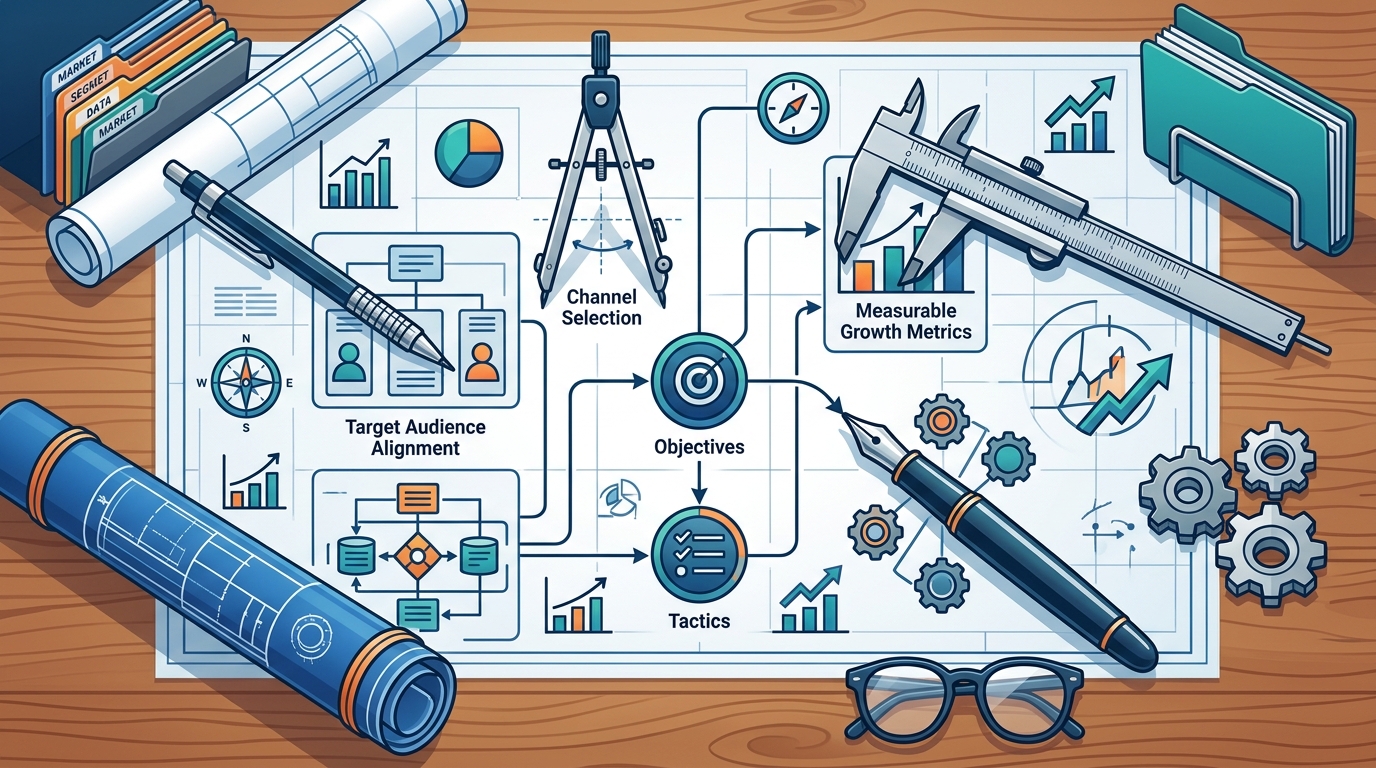
Choosing the right marketing strategy can feel overwhelming when dozens of channels compete for your budget and attention. The truth is that most businesses do not fail because they pick the wrong tactic; they fail because they never build a cohesive plan in the first place. A marketing strategy is a long-term blueprint that aligns your business goals, target audience, and budget with the channels most likely to deliver measurable growth. In this guide, we walk you through a clear, step-by-step framework so you can invest confidently and see real results.
1. Define Your Business Goals First
Every effective marketing strategy starts with clarity on what you want to achieve. Are you focused on brand awareness, lead generation, or direct sales? According to MarketingProfs research, 68% of small business owners expect their marketing budgets to increase in 2026, yet many still lack defined objectives tied to revenue.
Write down three or four concrete goals. Examples include increasing monthly qualified leads by 30%, reducing customer acquisition cost by 20%, or growing email subscribers to 5,000. These benchmarks become the filter through which every channel and tactic is evaluated.
2. Know Your Target Audience Inside and Out
A target audience is the specific group of consumers most likely to buy your product or service based on shared demographics, behaviors, and pain points. Without knowing who your ideal customer is, it is impossible to create messaging that resonates.
Build Buyer Personas
Document details like age, job title, income range, preferred platforms, and buying triggers. If you serve both B2B and B2C segments, create separate personas for each. Infinity Media works with both B2B and B2C lead generation clients, and the strategies differ significantly between the two.
Map the Customer Journey
Understand where prospects first discover you, what questions they ask before purchasing, and what objections they raise. This mapping exercise directly informs which channels deserve your investment.
3. Evaluate Core Marketing Channels
Not every channel suits every business. Below is a comparison of the most common digital marketing channels to help you weigh your options.
| Channel | Best For | Time to Results | Relative Cost |
|---|---|---|---|
| SEO & Content Marketing | Sustainable organic traffic | 3-6 months | Medium |
| PPC (Google Ads) | Immediate high-intent traffic | Days | High |
| Paid Social (Facebook/Instagram) | Awareness & retargeting | 1-4 weeks | Medium-High |
| Email & SMS Marketing | Nurturing & retention | Weeks | Low |
| Influencer Marketing | Brand credibility & reach | 2-8 weeks | Variable |
SEO and Content Marketing
SEO is the process of optimizing your website to rank higher in search engine results, increasing visibility, and driving organic traffic. For startups, focusing on keyword research, on-page optimization, and link-building lays the groundwork for long-term lead generation. Content marketing and SEO form one of the most powerful combinations for businesses seeking sustainable growth.
Paid Advertising
PPC advertising is a paid digital marketing strategy that involves bidding on keywords to display ads in search engine results. Platforms like Google Ads capture high-intent users who are ready to purchase. Infinity Media uses smart keyword buys and sophisticated targeting to find users searching for your exact products or services.
Email and SMS
Email marketing remains powerful because your list is an owned asset, independent of algorithm changes. Pair it with segmentation and personalization to drive engagement throughout the customer journey. Infinity Media builds email nurturing campaigns that have driven trial-to-subscription upgrades at a 300% higher rate for engaged users.
4. Set a Realistic Budget
Budget is the single biggest constraint for most businesses. A common benchmark is allocating 7-10% of gross revenue to marketing, though early-stage startups often invest more aggressively. The key is to work backward from your goals: determine your target cost per acquisition, then model how many conversions each channel can deliver at that cost.
Start small, test, and scale what works. As Entrepreneur reports, the businesses winning in 2026 do not run more campaigns; they design better systems. Allocate a test budget for experimenting with one new tactic each quarter without overcommitting resources.
5. Build a Multi-Channel Approach
The era of single-channel marketing success is over. Relying entirely on one platform leaves you vulnerable when algorithms change or costs spike. A practical multi-channel approach for most businesses includes Google presence for capturing search intent, social media for building awareness, and email for nurturing relationships.
Your channels should play different roles. Some excel at building awareness, others capture intent, and still others nurture consideration. The best strategies use channels that cover all three functions. Infinity Media takes this integrated approach with its comprehensive media plans that include audience segments, targeting, ad copy, and creatives across platforms.
6. Measure, Test, and Optimize
A marketing strategy without measurement is just guesswork. Track metrics that tie directly to revenue: customer acquisition cost, conversion rate, and lifetime value. Avoid vanity metrics like raw follower counts that look impressive but do not move the bottom line.
Run A/B tests on landing pages, ad creatives, and email subject lines. Infinity Media uses deep analytics and A/B testing to continuously improve funnel performance. Regularly analyze website performance using tools like Google Analytics, and adjust your approach as data reveals what resonates with your audience.
Key Takeaways
- Start every strategy by defining clear, revenue-tied goals before selecting channels.
- Build detailed buyer personas so your messaging speaks directly to real customer pain points.
- Evaluate channels based on your goals, timeline, and budget rather than chasing trends.
- Allocate 7-10% of revenue to marketing and reserve a portion for testing new tactics.
- Use a multi-channel approach to reduce risk and reach customers at every stage of the journey.
- Measure what matters: customer acquisition cost, conversion rate, and lifetime value.
- Partner with experienced strategists when you need to accelerate results without wasting budget.
Frequently Asked Questions
What is a marketing strategy?
A marketing strategy is a comprehensive plan that outlines how a business will reach its target audience, communicate its value proposition, and convert prospects into customers. It encompasses channel selection, messaging, budget allocation, and success metrics.
How much should a small business spend on marketing?
Most experts recommend allocating 7-10% of gross revenue to marketing. Early-stage startups may invest 15-20% to build initial traction. The right amount depends on your growth goals, industry competitiveness, and current brand awareness.
Which marketing channel has the highest ROI?
Search engine marketing consistently delivers strong ROI because it targets users actively searching for your products or services. However, the highest-ROI channel for your business depends on your audience, offer, and sales cycle length.
How long does it take to see results from a marketing strategy?
Paid channels like Google Ads can generate traffic within days. SEO and content marketing typically take three to six months to gain traction. Email marketing produces results within weeks when you have an existing subscriber list.
Should I focus on one channel or multiple channels?
A multi-channel approach is strongly recommended. Businesses that rely on a single platform are vulnerable to algorithm changes and cost increases. Focus on three to five high-impact channels and execute them consistently.
How do I know if my marketing strategy is working?
Track key performance indicators such as conversion rate, cost per acquisition, and return on ad spend. Review these metrics weekly and make data-driven adjustments. If KPIs are not trending toward your goals after 60-90 days, revisit your targeting or messaging.
When should I hire a marketing agency?
Consider an agency when you lack the in-house expertise to execute multi-channel campaigns, when your team is stretched too thin, or when you need to scale quickly. A specialized partner brings proven frameworks, dedicated account management, and cross-industry insights that accelerate results.
Ready to Build Your Strategy?
Choosing the right marketing strategy does not have to be a guessing game. When you combine clear goals, deep audience insight, and disciplined measurement, every marketing dollar works harder. If you want a tailored plan built around your unique business needs, explore Infinity Media's marketing packages or request a free consultation to discuss your growth goals with our team.