

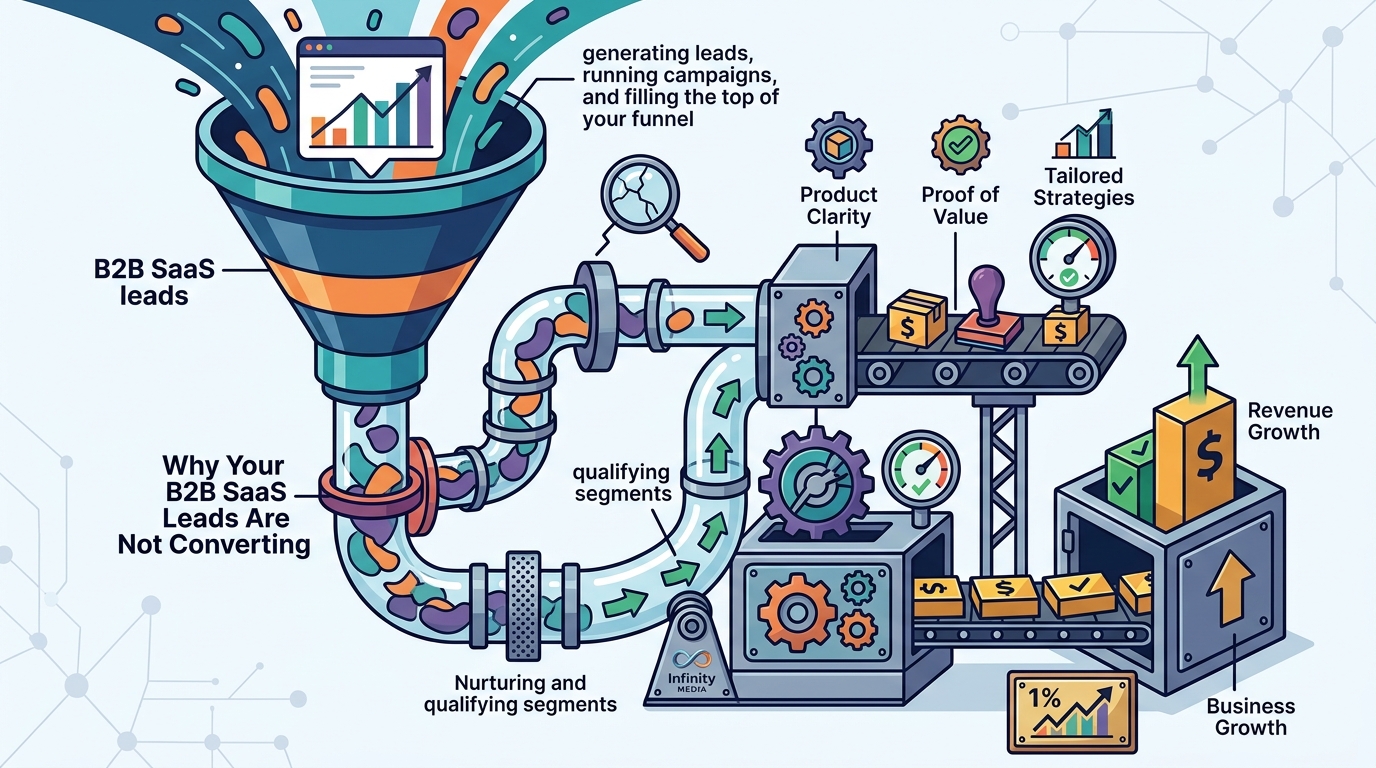
You are generating leads, running campaigns, and filling the top of your funnel. But the revenue is not following. If your B2B SaaS leads are not converting into paying customers, you are far from alone. The average B2B SaaS visitor-to-lead conversion rate sits at just 1.1% according to First Page Sage benchmarks, and the drop-off between marketing qualified leads and closed deals is even steeper. The good news: most conversion failures stem from a handful of fixable problems. This guide breaks down the root causes and gives you a clear path to turn more leads into revenue.
The B2B SaaS Conversion Benchmark Reality Check
Before diagnosing problems, you need to know what "normal" looks like. A conversion rate is the percentage of users who complete a desired action at any given funnel stage. In B2B SaaS, you track multiple conversion points, not just one number.
| Funnel Stage | Average Rate | Top Performer Rate |
|---|---|---|
| Visitor to Lead | 1.5 - 2.5% | 8 - 15% |
| Lead to MQL | 20 - 40% | 45%+ |
| MQL to SQL | 15 - 21% | 30%+ |
| SQL to Close | 20 - 25% | 30%+ |
According to 2025 B2B SaaS funnel research, the MQL-to-SQL stage is the key bottleneck, with average conversion of just 15 to 21%. If your numbers fall below these ranges, the problems below are likely culprits.
Problem 1: Misaligned Ideal Customer Profile
The most common reason B2B SaaS leads fail to convert is that they were never the right leads in the first place. An Ideal Customer Profile (ICP) is a detailed description of the company type most likely to become a high-value, long-term customer. When your ICP is too broad, your marketing attracts tire-kickers instead of decision-makers.
Symptoms of ICP Misalignment
High demo-request volume but low show rates. Prospects who ghost after the first call. Deals that stall because the lead lacks budget, authority, or genuine need. These patterns indicate a disconnect between your marketing strategy and the audience it reaches.
How to Realign
Audit your last 50 closed-won deals. Identify shared firmographic traits like company size, industry vertical, tech stack, and annual revenue. Then compare those traits against your current lead sources. Tighten ad targeting, adjust content topics, and update landing page messaging to speak directly to that profile.
Problem 2: Slow Lead Response Times
Speed-to-lead is the single strongest predictor of conversion. Research from Kixie shows that responding within 60 seconds can boost conversions by 391%, while the odds of qualifying a lead drop by 80% after five minutes. Yet the average B2B response time remains 42 to 47 hours.
For SaaS companies, this gap is devastating. Your prospect likely requested demos from two or three competitors simultaneously. The vendor who responds first wins the deal 78% of the time. Automated routing, instant calendar booking, and real-time CRM alerts are no longer optional.
Problem 3: Weak Lead Nurturing Sequences
Not every lead is ready to buy today. Lead nurturing is the process of building relationships with prospects through targeted content and timely follow-ups until they are sales-ready. Without it, warm leads go cold and competitors fill the gap.
What Effective Nurturing Looks Like
Map content to each funnel stage. Top-of-funnel leads need educational blog posts and industry insights, like the ones shared in our SaaS social media guide. Middle-of-funnel prospects respond to case studies, comparison guides, and webinars. Bottom-of-funnel leads need ROI calculators, implementation timelines, and peer testimonials.
Personalization Matters
Generic email blasts do not cut it in B2B SaaS. Segment your nurture sequences by industry, company size, and engagement level. Recent data shows roughly a 10% uplift in conversions when teams use AI-driven personalization across content and outreach.
Problem 4: Poor Lead Scoring and Qualification
Lead scoring is a methodology that ranks prospects based on their perceived value to your organization. When scoring criteria are vague or outdated, sales teams waste time on unqualified leads while hot prospects slip through the cracks.
The MQL-to-SQL Bottleneck
The MQL-to-SQL transition is where most SaaS funnels leak the hardest. When this rate falls below 15%, the usual culprits are weak scoring rules and slow SDR follow-up. Properly scored and qualified leads convert at 40%, compared to just 11% for unqualified prospects, according to 2026 lead qualification research.
Fixing Your Scoring Model
Combine behavioral signals (pages visited, content downloaded, email engagement) with firmographic fit (company size, industry, tech stack). Review and recalibrate scoring thresholds quarterly. Ensure marketing and sales agree on the definition of "qualified" before leads are handed off. This alignment is something Infinity Media's strategic growth consulting focuses on when auditing client funnels.
Problem 5: Funnel Friction and UX Failures
Over 76% of potential online sales are lost to form abandonment. Every unnecessary form field, confusing navigation step, or slow-loading page is a leak in your pipeline. The most important part of your funnel is the landing page flow, and even small UX improvements can produce outsized results.
Quick Wins to Reduce Friction
Replace static contact forms with embedded calendar booking. This single change can increase demo requests by over 30%. Reduce form fields to the absolute minimum needed for qualification. Use session recording tools to identify exactly where visitors drop off.
A/B testing is essential here. Experiment with headlines, CTAs, social proof placement, and page layouts. Companies using structured CRO strategies report a 223% ROI on their optimization efforts. If you are launching a new SaaS product, our guide to getting your first 100 paying users covers the foundational funnel principles you need.
Key Takeaways
- B2B SaaS average visitor-to-lead conversion is just 1.5 to 2.5%, so every funnel stage matters.
- ICP misalignment is the top reason leads fail to convert. Audit closed-won deals to refine targeting.
- Speed-to-lead is critical. Responding within 60 seconds can boost conversions by up to 391%.
- Lead nurturing with stage-appropriate, personalized content prevents warm leads from going cold.
- The MQL-to-SQL transition is the biggest bottleneck. Tighten scoring models and align sales and marketing.
- Reducing form friction and UX barriers delivers fast, measurable conversion gains.
- AI-driven personalization and automated qualification are producing 10 to 20% conversion lifts in 2025-2026.
Frequently Asked Questions
What is a good conversion rate for B2B SaaS?
The average visitor-to-lead rate for B2B SaaS is 1.5 to 2.5%. Top performers reach 8 to 15%. For SQL-to-close, aim for 25% or higher. Context matters: enterprise deals with longer sales cycles will naturally convert at lower rates than mid-market products.
Why are my MQLs not turning into SQLs?
The most common causes are loose lead scoring criteria, slow follow-up by SDRs, and misalignment between marketing and sales on what counts as "qualified." Tightening your scoring model and reducing response time are the fastest fixes.
How fast should I respond to inbound leads?
Under 60 seconds is the gold standard. Research shows that the odds of qualifying a lead drop by 80% after just five minutes. Implement automated routing and instant calendar booking to eliminate delays.
Does lead nurturing actually improve SaaS conversions?
Yes. Nurtured leads convert at significantly higher rates because they receive relevant, timely information that builds trust and addresses objections throughout the buying cycle. Personalized sequences outperform generic email blasts by a wide margin.
What is lead scoring in B2B SaaS?
Lead scoring is a methodology that assigns numerical values to leads based on behavioral signals and firmographic data. It helps sales teams prioritize high-intent prospects and avoid wasting time on unqualified contacts. Properly scored leads convert at roughly 4x the rate of unscored leads.
How do I reduce form abandonment on my SaaS landing pages?
Minimize the number of form fields, add progress indicators for multi-step forms, and consider replacing forms entirely with embedded scheduling tools. Implementing partial form capture can also recover leads who start but do not finish the submission.
Should I use AI for lead qualification?
AI-driven lead scoring and qualification tools can improve scoring speed by 20 to 30% and help teams focus on high-intent accounts. They are especially valuable for companies handling large lead volumes where manual review creates bottlenecks.
How long does it take to improve SaaS conversion rates?
Most new funnels can be significantly optimized within one to three months of focused testing. The timeline depends on traffic volume, because higher traffic allows you to run A/B tests faster and reach statistical significance sooner.
Ready to Fix Your Funnel?
Infinity Media specializes in conversion rate optimization and funnel management for B2B SaaS companies. Our team audits every stage of your pipeline, identifies the weak points, and implements data-driven fixes that turn more leads into customers. Get a free consultation and start converting the leads you are already generating.