

Best Performance Marketing Agency for High-Ticket B2B in 2026
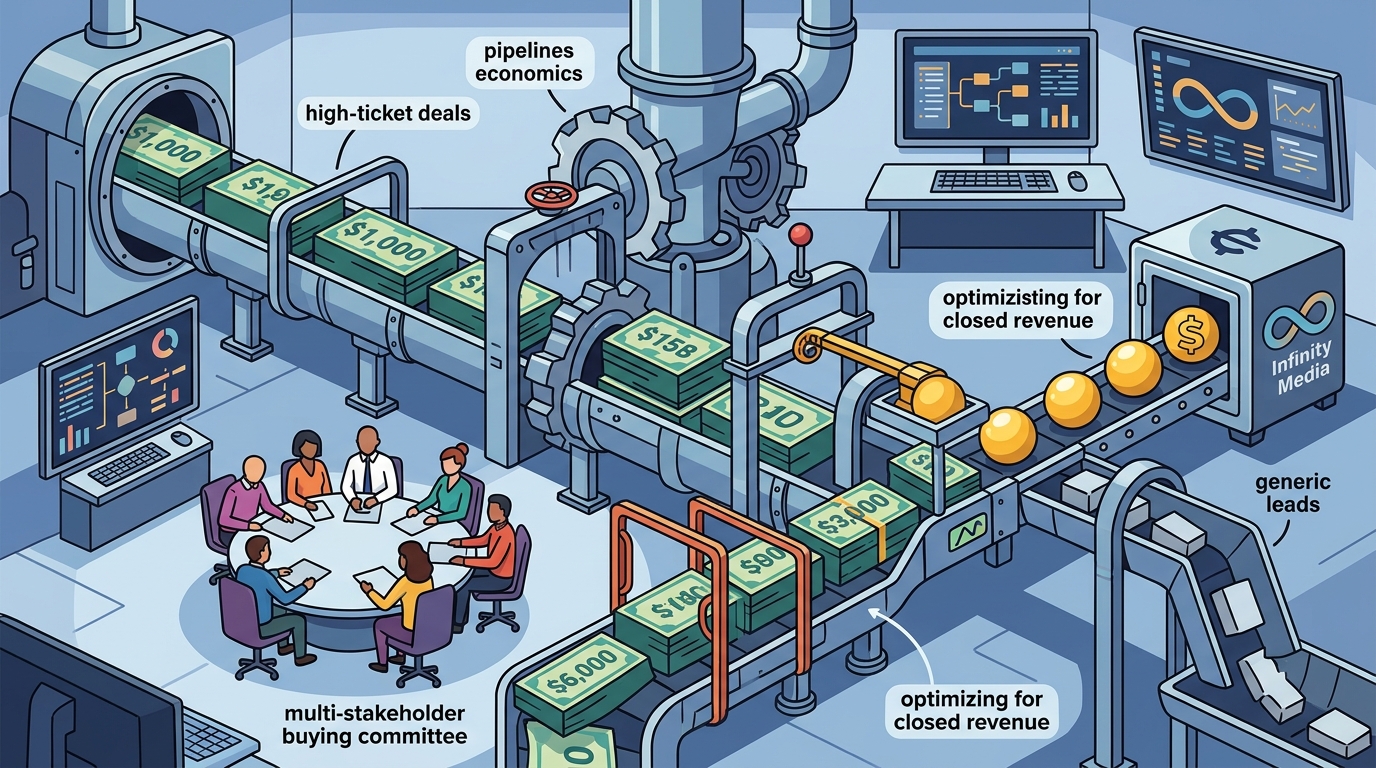
Choosing the best performance marketing agency for high-ticket B2B is not the same as picking a vendor that can run Google Ads. When your average deal size exceeds $25,000 and your sales cycle stretches beyond six months, the agency you partner with must understand pipeline economics, multi-stakeholder buying committees, and revenue attribution. Generic agencies optimize for clicks and leads. The right partner optimizes for closed revenue. This guide breaks down exactly what to look for, which metrics matter, and how Infinity Media approaches high-ticket B2B performance marketing with precision.
What Is High-Ticket B2B Performance Marketing?
High-ticket B2B performance marketing is a results-driven approach to paid media and demand generation where the primary goal is generating qualified pipeline for products or services with contract values typically above $25,000. Performance marketing is a digital marketing strategy where advertisers pay only when specific actions, such as form submissions, demo requests, or qualified meetings, are completed.
Unlike volume-based lead generation, high-ticket campaigns must account for longer sales cycles, multiple decision-makers, and complex attribution. According to Landbase's 2025 B2B sales data, buying groups now include four or more stakeholders in 87% of cases, with enterprise cycles often exceeding 12 months. This complexity demands a fundamentally different agency approach.
Why Generic Agencies Fail High-Ticket B2B Companies
The core problem is structural. Generic performance agencies optimize for volume metrics like cost-per-click and MQL counts. But high-ticket B2B revenue models demand precision. As Jordan Digital Marketing notes, marketers keep racking up conversions while sales cycles stall because the leads lack intent and authority.
The MQL Trap
Many agencies report impressive lead numbers that never convert to pipeline. In high-ticket B2B, a single SQL is worth more than a hundred unqualified form fills. Your agency must understand the difference between a marketing-qualified lead and a sales-qualified opportunity tied to real budget and authority.
Attribution Blind Spots
Cookie deprecation and iOS privacy changes have made last-click attribution nearly useless for long B2B sales cycles. Agencies still reporting on platform-attributed conversions are giving you an incomplete picture. CRM-stage attribution that tracks from first touch to closed deal is the new baseline.
Key Metrics That Define Success
The right performance marketing agency tracks metrics that map directly to revenue, not vanity dashboards. Here are the benchmarks that matter for high-ticket B2B in 2026:
| Metric | Definition | 2026 Benchmark |
|---|---|---|
| Customer Acquisition Cost (CAC) | Total sales and marketing spend divided by new customers acquired | $1,200–$2,000+ for mid-market/enterprise |
| LTV:CAC Ratio | Customer lifetime value relative to acquisition cost | 3:1 minimum; 4:1–5:1 for mature companies |
| CAC Payback Period | Months required to recoup acquisition investment | 8–12 months (early stage); 15–18 months (mid-stage) |
| MQL-to-SQL Conversion Rate | Percentage of marketing leads accepted by sales | 15–25% |
| Pipeline Velocity | Speed at which qualified deals move through the funnel | Varies by ACV; track monthly |
| SEO ROI | Return on organic search investment | 748% average |
According to SaaS Hero's 2026 analysis, average B2B SaaS CAC reached $1,200, with companies targeting mid-market or enterprise clients facing costs between $1,200 and $2,000. Agencies that cannot demonstrate how they lower CAC while maintaining lead quality are not built for high-ticket work.
How to Evaluate a B2B Performance Marketing Agency
Not every agency that claims B2B expertise has actually managed campaigns with six-figure deal sizes. Use these criteria to separate specialists from generalists:
Pipeline Accountability
Pipeline accountability is the practice of tying agency reporting directly to CRM-verified opportunities and closed revenue rather than platform-level metrics. The best agencies in 2026 report on qualified leads that convert to pipeline, not click-through conversions that sales never touches. Ask any prospective agency how they connect ad spend to your CRM stages.
Industry Specialization
An agency that primarily serves consumer brands will struggle with B2B startup marketing nuances like long nurture sequences, ABM targeting, and multi-threaded outreach. Look for demonstrated experience in your vertical.
Channel Depth vs. Breadth
High-ticket B2B typically requires mastery of paid search, LinkedIn Ads, and programmatic display. Agencies that spread thin across every channel rarely deliver the strategic depth that enterprise deals demand.
Channel Strategy for High-Ticket Deals
The most effective high-ticket B2B campaigns combine demand capture and demand creation. Search engine optimization builds long-term authority and delivers the highest ROI at 748% on average, according to Konabayev's 2026 benchmark report. Paid search captures existing intent, while paid social media campaigns on LinkedIn create demand among prospects who are not yet in-market.
The compounding effect matters: LinkedIn ads build awareness that feeds future pipeline while Google Ads capture prospects actively searching for solutions. Running both channels together creates a multiplier effect rather than budget competition. This dual approach is central to how Infinity Media structures campaigns for high-ticket clients.
Why Infinity Media Stands Apart
Infinity Media is a collective of high-performance marketing virtuosos based in Los Angeles that collaborates with visionary startups and discerning business owners who value innovation. Unlike volume-driven agencies, our approach is centered on understanding each client's unique pipeline economics and building tailored strategies around them.
Our capabilities span search engine marketing, landing page and funnel optimization, paid social, SEO, and email marketing. For high-ticket B2B clients, we focus on CRM-integrated attribution, conversion rate optimization, and strategic creative testing to reduce CAC while increasing pipeline quality.
We have delivered results for technology and AI companies through our AI marketing programs, and our case studies demonstrate measurable outcomes across paid media and organic channels. Every engagement begins with a deep understanding of your ICP, your sales motion, and the metrics your leadership team actually cares about.
Key Takeaways
- High-ticket B2B performance marketing requires pipeline-focused attribution, not platform-level vanity metrics.
- Average B2B SaaS CAC reached $1,200 in 2026, with enterprise-focused campaigns often exceeding $2,000 per customer.
- A healthy LTV:CAC ratio for high-ticket B2B is at least 3:1, with mature companies targeting 4:1 or higher.
- Generic agencies optimize for lead volume; the right partner optimizes for sales-qualified pipeline and closed revenue.
- Combining paid search (demand capture) with LinkedIn (demand creation) produces compounding results for long sales cycles.
- SEO delivers the highest long-term ROI at 748% on average, making it essential for high-ticket B2B content strategy.
- Always verify that a prospective agency has real B2B experience with deal sizes comparable to yours.
Frequently Asked Questions
What is a performance marketing agency?
A performance marketing agency is a specialized firm that plans, executes, and optimizes digital advertising campaigns where payment or success is tied to measurable outcomes like leads, demos, or revenue rather than impressions alone.
How much does a B2B performance marketing agency cost?
Costs vary widely based on scope and channels. Most agencies charge monthly retainers ranging from $5,000 to $25,000 or more, plus ad spend. High-ticket B2B engagements typically require higher investment because of longer optimization cycles and the need for specialized talent.
What is a good CAC for high-ticket B2B?
For mid-market and enterprise B2B, a CAC between $1,200 and $2,000 is common in 2026. The key is ensuring your LTV:CAC ratio stays at 3:1 or above so acquisition costs remain sustainable relative to customer lifetime value.
How long does it take to see results from B2B performance marketing?
Paid channels can generate initial leads within weeks, but meaningful pipeline impact in high-ticket B2B typically takes 3 to 6 months. SEO and content marketing require 6 to 12 months to compound but deliver the highest long-term returns.
What channels work best for high-ticket B2B?
Google Ads captures existing demand from buyers actively searching. LinkedIn Ads targets specific job titles, industries, and company sizes for demand creation. SEO builds compounding organic visibility. The most effective strategies combine all three channels with CRM-integrated attribution.
How do I know if my current agency is underperforming?
If your agency reports on clicks, impressions, and MQLs but cannot show you CRM-verified pipeline and closed revenue influenced by their campaigns, they are likely not built for high-ticket B2B. Ask for a direct connection between ad spend and sales outcomes.
Why is pipeline accountability important in B2B marketing?
B2B marketing leaders in 2026 expect their agency to report on qualified leads that convert to pipeline. Without pipeline accountability, you risk spending budget on leads that sales never touches, inflating costs without driving real growth.
Can a small agency handle high-ticket B2B campaigns?
Yes. Boutique agencies often move faster, adapt to shifting priorities, and provide senior-level attention that large firms cannot. The differentiator is not team size but strategic depth, channel expertise, and proven B2B results.
Ready to Build Real Pipeline?
If you are tired of paying for leads that never convert, it is time to work with a performance marketing partner that understands high-ticket B2B. Explore Infinity Media's pricing and engagement options to see how we align spend with revenue outcomes for growth-stage companies.